


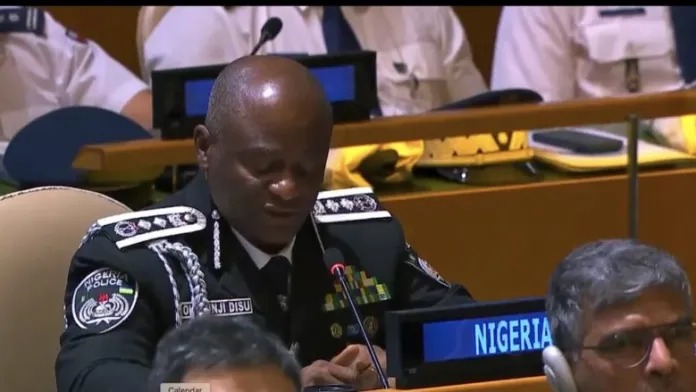
Nigeria has renewed its commitment to stronger international policing as Inspector-General of Police, IGP Olatunji Rilwan Disu, called for closer global cooperation to tackle modern security threats.
The message came during one of the world’s biggest gatherings of police leaders at the United Nations Headquarters in New York.
The IGP Disu at UN Police Summit drew attention as global security experts discussed how criminal groups are becoming more organised through technology.
Moreover, Nigeria used the platform to advocate stronger partnerships that can better respond to terrorism, cybercrime, and cross-border criminal activities.
The Fifth United Nations Chiefs of Police Summit (UNCOPS 2026) was held from July 7 to July 8. Ministers, Inspectors-General of Police, police chiefs, and senior security officials from across the world attended the high-level meeting.
Furthermore, the summit focused on improving international peace, security, and development through stronger cooperation between national police services and the United Nations.
During his address, IGP Disu stressed that crime is changing rapidly across the globe. He explained that criminal organisations now rely on advanced technology to evade law enforcement agencies.
According to him, modern criminal groups continue to exploit artificial intelligence, encrypted communication, and cyber-enabled platforms to expand their activities across different countries. Therefore, traditional policing methods alone are no longer enough to confront these growing threats.
The Inspector-General also highlighted the opportunities created by technology. He noted that artificial intelligence, digital forensics, and geospatial intelligence can strengthen investigations and improve policing outcomes.
However, he warned that technology should never replace public confidence in law enforcement.
He said innovation must always support transparency, accountability, respect for human rights, and the rule of law. These values, he explained, remain the foundation of effective policing in every society.
Addressing delegates at the summit, IGP Disu said modern criminal networks are increasingly exploiting artificial intelligence, encrypted communications, and cyber-enabled platforms to operate across borders with greater sophistication, making security challenges more complex.
He further emphasized that while technology presents significant opportunities for law enforcement through artificial intelligence, digital forensics, and geospatial intelligence, public trust remains the foundation of effective policing.
According to the Inspector-General, “innovation must reinforce transparency, accountability, respect for human rights, and adherence to the rule of law.”
Furthermore, the police chief called for stronger international partnerships among member states. He encouraged countries to invest more in capacity building while ensuring that all nations have equal access to digital policing tools.
According to him, advanced policing technology should not be available only to a few developed countries. Instead, every nation should benefit from innovations that improve security and crime prevention.
The summit also served as an opportunity for participating countries to exchange ideas on improving law enforcement cooperation. In addition, discussions focused on strengthening peacekeeping operations and building effective responses to emerging security threats.
Nigeria’s participation further reflects the country’s growing commitment to international security partnerships. Meanwhile, the government continues to support collaborative efforts aimed at reducing terrorism, organised crime, cybercrime, and other cross-border offences.
The IGP Disu at UN Police Summit also reinforces Nigeria’s role in global peacekeeping missions and international policing initiatives.
Moreover, experts agree that sharing intelligence, improving technology, and strengthening partnerships will help law enforcement agencies respond faster to evolving threats.
The Nigeria Police Force maintained that international collaboration remains one of the most effective ways to improve public safety worldwide. Therefore, greater cooperation between nations is expected to strengthen global efforts against organised crime.