

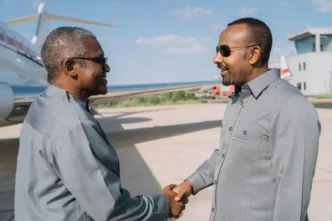
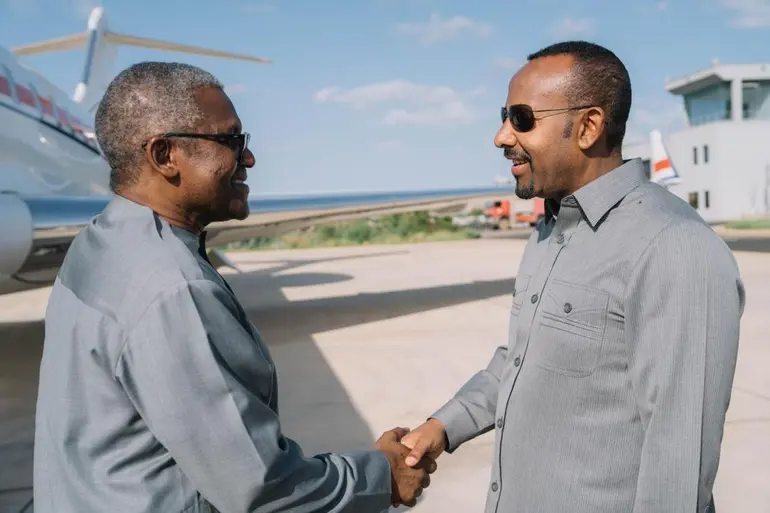
Africa’s richest businessman, Aliko Dangote, has stunned many across the continent after increasing his Ethiopia fertiliser investment to more than $4 billion during a high-profile visit to the project site in Gode.
The massive industrial project, which is already under construction, is expected to transform Ethiopia’s agriculture sector and reduce heavy dependence on imported fertiliser.
The investment is now being described as one of the biggest private industrial projects in East Africa.
Dangote visited the construction site alongside Ethiopian Prime Minister Abiy Ahmed, who praised the project as a major step toward economic independence and food security.
Meanwhile, the expanded investment has drawn attention across Africa because of its scale and long-term impact.
The upgrade now includes a 110-kilometre pipeline, a 120MW power plant, a polypropylene packaging facility, and a two-million-tonne NPK blending plant.
According to Dangote Group, the total investment rose sharply from the earlier announced $2.5 billion.
“Dangote announced an increase in investment from $2.5 billion to over $4 billion,” the company confirmed in a statement.
The fertiliser plant is expected to produce three million metric tonnes of urea every year once operations begin fully in 2029. Furthermore, the facility will supply Ethiopia and neighbouring East African countries.
Ethiopia currently imports all inorganic fertiliser used by local farmers. However, this project is expected to change that situation completely once production starts.
Speaking during the inspection visit, Dangote stressed the importance of African-led industrial growth.
“Africa has the capacity to feed itself and even export to the rest of the world,” Dangote said.
The billionaire businessman also noted that the project represents more than business expansion.
Meanwhile, Prime Minister Abiy Ahmed described the investment as critical to Ethiopia’s future.
“This initiative represents far more than infrastructure. It is a strategic investment in Ethiopia’s agricultural transformation, food security, industrial growth, and economic self-reliance,” Abiy stated.
The Ethiopian leader further explained that the project would reduce import dependence while creating jobs and new opportunities for millions of citizens.
“Once completed, the fertiliser plant will play a vital role in strengthening local production capacity,” he added.
In addition, Abiy praised the speed of construction work already ongoing at the project site.
“This morning, together with Aliko Dangote, I visited the project site in Gode to assess the progress achieved so far,” he said.
The project is jointly owned by Dangote Group and Ethiopian Investment Holdings. Dangote Group controls 60 percent of the investment, while the Ethiopian government owns 40 percent.
Furthermore, the project adds to Dangote Group’s growing presence across Africa in sectors including cement, agriculture, petrochemicals, and manufacturing.