




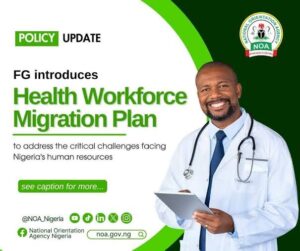
The Federal Government has unveiled an ambitious plan to tackle Nigeria’s shortage of healthcare professionals by dramatically increasing admissions into health-related programmes across the country.
The move comes as the administration pushes to strengthen the nation’s healthcare system and prepare more young Nigerians for opportunities in the global labour market.
According to the Minister of Education, Dr. Maruf Tunji Alausa, annual admissions into nursing schools have risen from about 20,000 students before the current administration took office to nearly 50,000. Moreover, enrolment into medicine, pharmacy and dentistry programmes has also been expanded to meet the growing demand for skilled healthcare workers.
The expansion initiative is expected to reshape Nigeria’s medical education sector over the next few years. Furthermore, the government believes the increased number of graduates will gradually reduce the shortage of doctors, nurses, pharmacists and other critical health professionals across the country.
Speaking during an interview with reporters in Abuja, Alausa said the reforms were introduced to build a stronger education system capable of producing highly skilled graduates.
He explained that education remains a key driver of President Bola Tinubu’s economic agenda and plays a major role in achieving the administration’s one trillion-dollar economy target.
According to the minister, the government is investing heavily in education because it sees young Nigerians as the country’s greatest resource. In addition, he noted that Nigeria already produces professionals who contribute to economies across Africa and other parts of the world.
“We want to be the manpower supplier of the world. We need to produce competent, skilled and educated young Nigerians who will drive our economy, contribute to Africa’s growth and compete successfully across the world.
“As the president advances his vision of building a one trillion-dollar economy, education will remain at the centre of that transformation,” he stated.
Meanwhile, Alausa explained that expanding admissions alone would not solve the country’s challenges. Therefore, the government is also focusing on improving the quality of education and ensuring graduates meet international standards.
The minister added that investments have continued in skills development, higher education reforms and training programmes.
The healthcare workforce expansion is also being supported through the Nigerian Education Loan Fund (NELFUND). According to Alausa, the scheme has been carefully designed to remain sustainable for future generations of students.
He stressed that President Tinubu had instructed government officials to ensure that every major reform introduced by the administration remains effective long after the current government leaves office.
“There is no value in introducing policies that cannot stand the test of time. Sustainability is central to this administration’s philosophy, and that principle guided the design of NELFUND,” he said.
Furthermore, the minister highlighted what he described as improved industrial peace within Nigeria’s tertiary institutions. He credited the achievement to the administration’s willingness to engage university unions through dialogue and mutual understanding.
According to him, the Federal Government fulfilled its promise by paying 50 percent of withheld salaries inherited from previous disputes. Consequently, confidence between the government and academic unions has improved significantly.
He also disclosed that workers in tertiary institutions received salary increases of nearly 40 percent as part of efforts to improve staff welfare while maintaining responsible government spending.
Moreover, Alausa said agreements reached with university unions have been practical and affordable. He maintained that the renewed atmosphere of cooperation is already producing positive results across Nigeria’s higher education sector.