

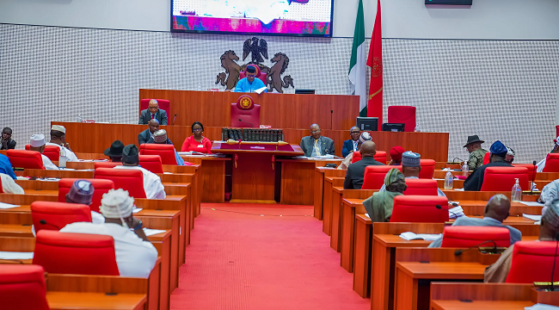
Nigeria has moved a step closer to changing its policing system after the Senate passed the proposed State Police Bill.
The development came as lawmakers approved all 26 clauses of the bill during deliberations on Wednesday.
The decision marks shifts in Nigeria’s security structure since the return to democratic rule in 1999.
For years, the idea of state controlled police forces remained controversial. However, worsening cases of banditry, kidnapping, terrorism, and communal clashes have renewed calls for a more localized security approach.
The State Police Bill seeks to create a legal framework that would allow states to establish their own police services while maintaining the existing federal police structure.
Leading the debate, Senate Leader Opeyemi Bamidele described the proposal as a landmark reform.
“This important Bill is an Executive Bill transmitted by Mr. President and Commander-In-Chief of the Armed Forces of the Federal Republic of Nigeria, seeking to alter the Constitution to provide for the establishment of State Police Services and other related matters,” he said.
Bamidele added that the legislation addresses concerns about the effectiveness of Nigeria’s centralized policing system.
“This Bill represents one of the most significant constitutional reforms in our nation’s democratic evolution.”
According to him, the federal police would continue handling terrorism, cybercrime, organized crime, border security, and other national security matters. Meanwhile, state police services would focus on enforcing state laws, maintaining public order, and protecting lives and property within their jurisdictions.
However, concerns about possible abuse of state police powers were raised during the debate.
To address those fears, the bill contains safeguards designed to prevent governors and political leaders from using police formations for personal or political interests.
Senator Enyinnaya Abaribe revealed that he had previously opposed state police but changed his position due to the country’s security challenges.
“Mr. President, I used to be one of those that is against state police. Mark my words; I used to be,” he said.
“But today, we know that we have very serious insecurity problem that can only be solved by thinking outside the box.”
Similarly, Senator Aminu Tambuwal expressed support for the proposal, describing it as an important step toward strengthening federalism and improving security nationwide.
Despite the Senate’s approval, the process is not yet complete. The constitutional amendment must still receive support from at least two-thirds of the 36 state Houses of Assembly before it can be transmitted to President Bola Tinubu for assent.