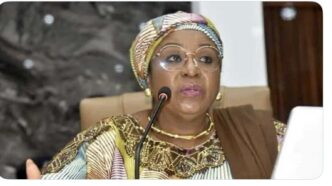
Concerns have emerged over the Federal Government’s 2026 budget after former Minister of Youth and Sports, Solomon Dalung, questioned the decision to allocate nearly ₦963 billion to empowerment projects and Sport Utility Vehicles (SUVs).
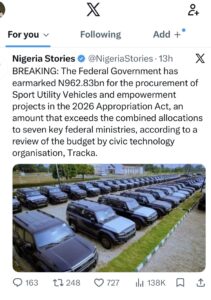
The 2026 Federal Government budget has come under fresh scrutiny after civic technology organisation Tracka revealed that the combined allocation for empowerment projects and SUVs is higher than the total budget of seven major federal ministries.
Moreover, Dalung argued that the spending sends the wrong message while citizens are repeatedly urged to endure economic hardship.
Advertisement
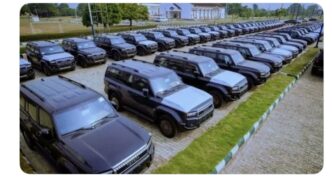
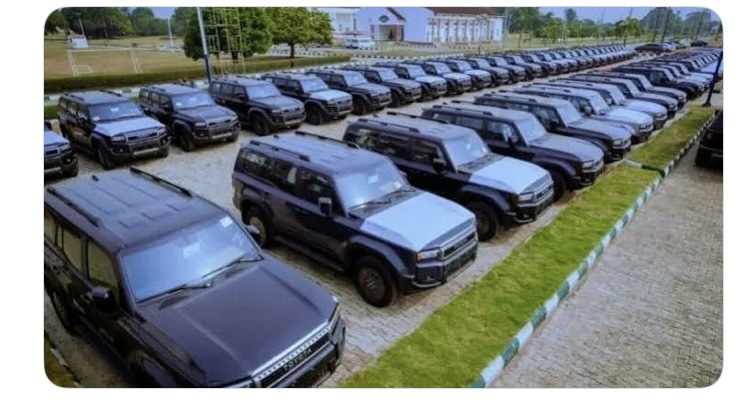
According to Tracka, the Federal Government set aside ₦947.7 billion for 2,579 empowerment projects in the 2026 Appropriation Act. In addition, another ₦15.13 billion was budgeted for the procurement of 39 Sport Utility Vehicles, bringing the total allocation to ₦962.83 billion.
Tracka noted that the amount exceeds the combined ₦960.27 billion allocated to seven important ministries. These include the Ministries of Industry, Trade and Investment, Housing and Urban Development, Women Affairs, Justice, Livestock Development, Aviation and Aerospace Development, and Petroleum Resources.
However, the organisation also raised concerns over transparency in the implementation of the projects.
According to Tracka, “only 70 of the 2,579 empowerment projects have clearly identified implementation locations.”
Reacting to the findings, Dalung criticised what he described as misplaced priorities in the budget.
“There is something deeply troubling about a government asking Nigerians to endure pain, hunger, and economic hardship in the name of ‘necessary sacrifices’ while the same government presides over a budget where nearly ₦1 trillion is tied to questionable priorities.”
He questioned why empowerment projects alone received more funding than ministries responsible for driving national development.
“The problem is not empowerment. Nigerians need support. Our young people need opportunities. Our vulnerable citizens need intervention.”
“The problem is a system where billions can be inserted into thousands of vaguely defined projects, many without clear locations, transparent beneficiaries, or measurable outcomes.”
Furthermore, Dalung argued that transparency remains essential in public spending because citizens deserve to know how their tax money is being used.
He maintained that unclear project descriptions create doubts about whether public funds are reaching those who truly need assistance.
Screenshot
“When citizens cannot see where money is going, it raises doubts about whether the programmes are truly designed to empower the poor or simply to empower the politically connected.”
The former minister also questioned the government’s call for sacrifice while large sums continue to be allocated to projects many Nigerians struggle to understand.
“A government cannot preach sacrifice to struggling families while maintaining a culture of unexplained spending at the top.”
Moreover, he said ordinary Nigerians are demanding accountability rather than promises.
“Nigeria does not lack resources. We lack a political culture that places accountability above convenience and public interest above political patronage.”
Dalung further described the national budget as a reflection of government priorities.
“A budget is a moral document. It reveals who matters. And Nigerians deserve to know: who exactly are these billions empowering?”
Meanwhile, the Federal Government has yet to publicly respond to Dalung’s remarks or the concerns raised by Tracka regarding the implementation details of the empowerment projects.