

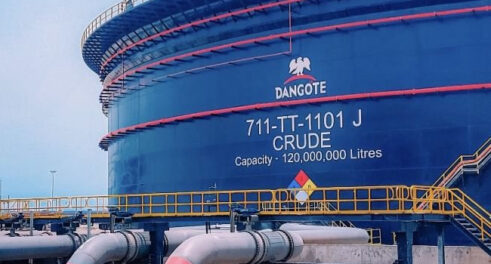
Nigeria’s downstream oil sector is undergoing a major shift as the Dangote Petroleum Refinery ramps up production and reduces the country’s long-standing reliance on imported fuel.
Dangote Refinery impact on Nigeria fuel market has continued to draw attention after new data showed that domestic supply is improving rapidly.
According to the Economist Intelligence Unit (EIU), the refinery is fundamentally changing Nigeria’s downstream structure, which had long depended on imports despite being Africa’s biggest crude oil producer.
The report noted that the refinery, with a capacity of 650,000 barrels per day, supplied nearly 80 percent of Nigeria’s petrol demand in April. In addition, it stated that output levels are now sufficient to meet most domestic consumption needs.
The EIU described the pre-refinery system as “long dysfunctional,” pointing out that state-owned refineries had remained inactive for years.
“The gradual ramp up of the 650,000 barrel/day Dangote refinery since May 2023 has transformed Nigeria’s long dysfunctional downstream sector; the country’s main refineries, all state owned, had been inoperative for years and Nigeria was almost entirely reliant on costly imported fuel,” the report noted.
Furthermore, the report explained that reduced import needs have strengthened Nigeria’s external position and improved its balance of payments.

According to the EIU, full capacity operations and planned expansion will further boost Nigeria’s economic performance in the coming years.
“Meanwhile, the attainment of full capacity and an increase in exports from the Dangote refinery will support real GDP growth and foreign exchange earnings in 2026 and 2027 and beyond, as a planned doubling of the plant’s output comes on stream around the end of the decade,” it added.
Meanwhile, analysts say the refinery is already positioning Nigeria as an emerging refining hub in Africa.
The Nigerian Midstream and Downstream Petroleum Regulatory Authority (NMDPRA) recently relaxed import restrictions.
Dangote Industries has since taken legal steps, arguing that continued fuel import approvals could weaken local refining investment and contradict the Petroleum Industry Act’s goals.
Moreover, industry experts say the rise of large-scale domestic refining has strengthened Nigeria’s energy security and reduced exposure to global supply shocks.
S&P Global Ratings also recently upgraded Nigeria’s sovereign credit outlook, citing improved hydrocarbon output and growing refining capacity as key drivers.