

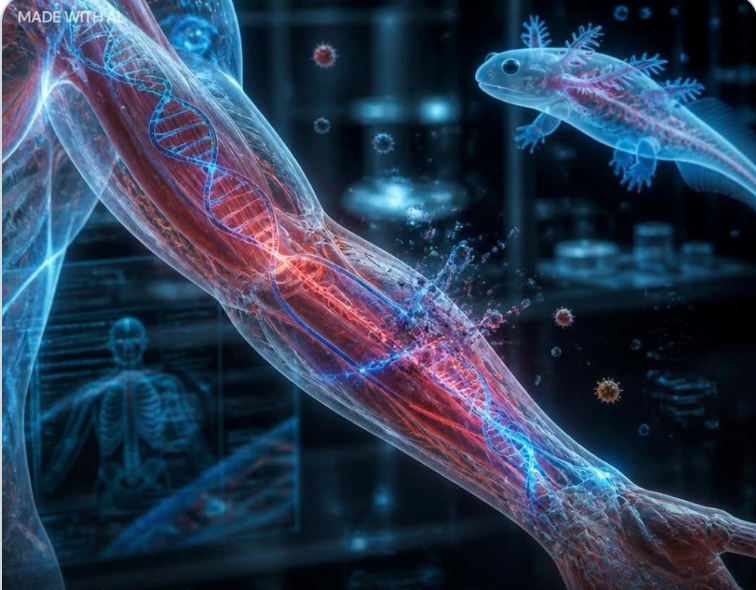
A discovery in biological research has raised new questions about whether humans may one day regenerate lost body parts.
Scientists studying axolotls, a species known for regrowing entire limbs, have found genetic similarities that also exist in humans.
The finding has sparked renewed interest in whether human tissue repair could be far more powerful than previously believed. Moreover, researchers now suggest the key mystery may not be the absence of regeneration genes, but their inactivity within the human body.
Axolotls have long fascinated scientists because they can fully regrow limbs, spinal tissue, and other complex body parts without scarring. In contrast, human healing is limited to wound repair and partial tissue regeneration.
However, new studies supported by the National Science Foundation indicate that humans may still carry ancient biological pathways linked to regeneration. These pathways appear similar to those activated in axolotls during limb regrowth.
According to scientists, the central question is not whether these genes exist, but why they remain switched off. Furthermore, understanding how axolotls activate regeneration could help unlock similar processes in humans.
In addition, early findings suggest that the biological instructions for regrowth may still be present in humans, but suppressed by evolutionary changes over time.
Therefore, researchers are increasingly optimistic that studying regenerative species like axolotls could eventually reshape treatments for injuries, amputations, and degenerative diseases.