




Nigeria’s growing lithium mining in Nigeria sector has received a boost after Chariot Corporation secured key regulatory approvals for multiple licences.
The approvals, which were granted by the Mining Cadastre Office (MCO), signal a turning point not only for the company but also for Nigeria’s emerging lithium industry.
Moreover, the development has positioned the country more firmly on the global mineral map.
Chariot has now strengthened its foothold in Nigeria through its local joint venture, C&C Minerals Limited. Therefore, attention is shifting toward how quickly operations may advance.
According to the company, six licences were approved for transfer, including four exploration licences and two small-scale mining licences. These licences were moved from Continental Lithium Limited to C&C Minerals, consolidating control under Chariot’s structure.
The approved licences cover exploration sites at Fonlo and Gbugbu, as well as mining interests at the Saki project. In addition, this consolidation is expected to simplify operations and improve efficiency across the projects.
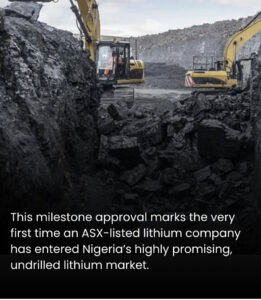
“This approvals are monumental for the Company and indeed the global lithium sector as they signify the first entry of an ASX-listed lithium company into the high-potential lithium sector in Nigeria, which hosts lithium pegmatites that are already producing spodumene for the Chinese market but remain almost entirely undrilled,” said Shanthar Pathmanathan, Executive Chairman & Managing Director of Chariot.
Furthermore, the approvals bring Chariot closer to completing its acquisition of a 66.667 percent stake in C&C Minerals. Meanwhile, Continental Lithium will retain the remaining 33.333 percent interest.
This milestone has been described by the company as a major step in reducing risk tied to its Nigerian investment. In addition, it provides a clearer path toward full-scale exploration and development.
Despite the progress, four additional licences are still awaiting final approval. These include three located in Saki and one in Iganna.
Meanwhile, independent laboratory tests have revealed encouraging mineral results across the project areas. The analysis was conducted by the University of British Columbia.
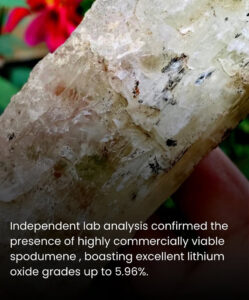
Results confirmed the presence of high-value spodumene across all six sampled sites. Moreover, the mineral content ranged between 28.4 percent and 75.3 percent of crystalline composition.
These findings are significant because spodumene is one of the most commercially viable lithium minerals. In addition, it is easier to process compared to alternatives like lepidolite.
Notably, lepidolite was not detected in any of the samples, which further strengthens the commercial outlook.
The samples also recorded lithium oxide grades ranging from 2.66 percent to 5.96 percent. These levels are considered strong and suggest high-grade mineral deposits.
In addition, elevated caesium levels were discovered, with pollucite reaching up to 9.5 percent in one Iganna sample. This indicates strong lithium-caesium-tantalum potential within the المنطقة.
Chariot has stated that the results will guide its next steps, including drilling and expanded fieldwork. Furthermore, plans for small-scale mining assessments are already being considered.
The company also noted that the approvals and test results together reduce uncertainty around its projects. Therefore, development timelines could be accelerated in the coming months.
This latest development reflects a broader shift toward resource diversification in Nigeria’s economy.












Good for diversification. But will Nigeria gain any revenue from this agreement? Ire ooo