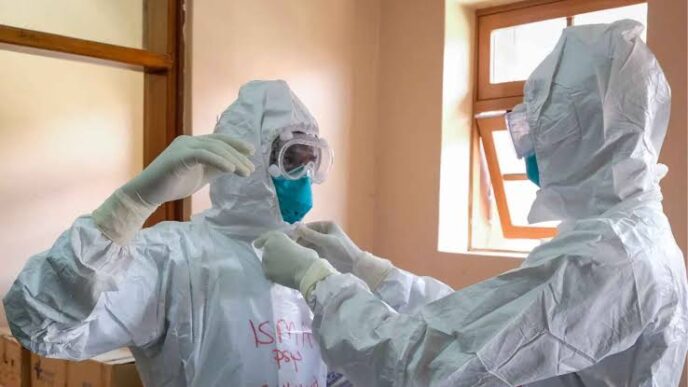




The Federal Government has revealed plans to tighten border controls and possibly restrict flights from countries battling Ebola outbreaks.
The move comes amid growing concern over the rapid spread of the deadly virus in parts of Africa, especially the Democratic Republic of Congo and Uganda.
Moreover, top government officials say urgent measures are being considered to prevent another public health crisis in Nigeria.
The Ebola prevention measures were discussed during a high-level emergency meeting held in Lagos on Thursday.
The meeting involved officials from the Nigeria Centre for Disease Control and Prevention, the Ministry of Interior, and the Lagos State Government.
Chief of Staff to the President, Femi Gbajabiamila, disclosed that the government was already reviewing several safety options.
These include tighter airport screening, isolation of suspected passengers, and possible restrictions on flights from affected countries.
“We have a health scare, which is Ebola, and we all know what happened the last time. The cases are getting worse internationally, and we don’t want to leave anything to chance,” Gbajabiamila said.
Furthermore, he revealed that President Bola Tinubu had already been fully briefed on the situation.
According to him, the government remains determined to stop the virus from entering the country.
“We looked at the possibility of restricting flights from countries of interest. We also considered isolating passengers who may exhibit symptoms of Ebola and putting protocols in place because prevention is better than cure,” he added.
Meanwhile, the Minister of Interior, Olubunmi Tunji-Ojo, announced stricter monitoring across Nigeria’s borders and entry points.
He explained that immigration officials would work closely with health authorities to improve early detection systems.
In addition, the Nigeria Immigration Service is expected to strengthen passenger screening procedures at airports and land borders.
NCDC Director-General, Dr. Jide Idris, warned that Ebola remains one of the world’s deadliest viral diseases.
He stressed the importance of rapid response and public awareness to reduce possible risks.
“Ebola remains a deadly virus with no treatment, no vaccines,” Idris said.
He further explained that preparedness plans had already been activated in all 36 states.
Healthcare workers have also reportedly been placed on emergency alert as authorities intensify surveillance.
Meanwhile, the World Health Organisation recently confirmed 10 Ebola deaths and over 223 suspected deaths in DR Congo since the latest outbreak began in mid-May.
However, Nigerian authorities insist there is currently no confirmed Ebola case in the country.
Experts say the latest government response reflects lessons learned from Nigeria’s successful containment of Ebola during the 2014 outbreak.
Furthermore, public health analysts have urged Nigerians to remain calm while following official health advisories.
The government also encouraged citizens to report suspected symptoms early and avoid unnecessary panic.