

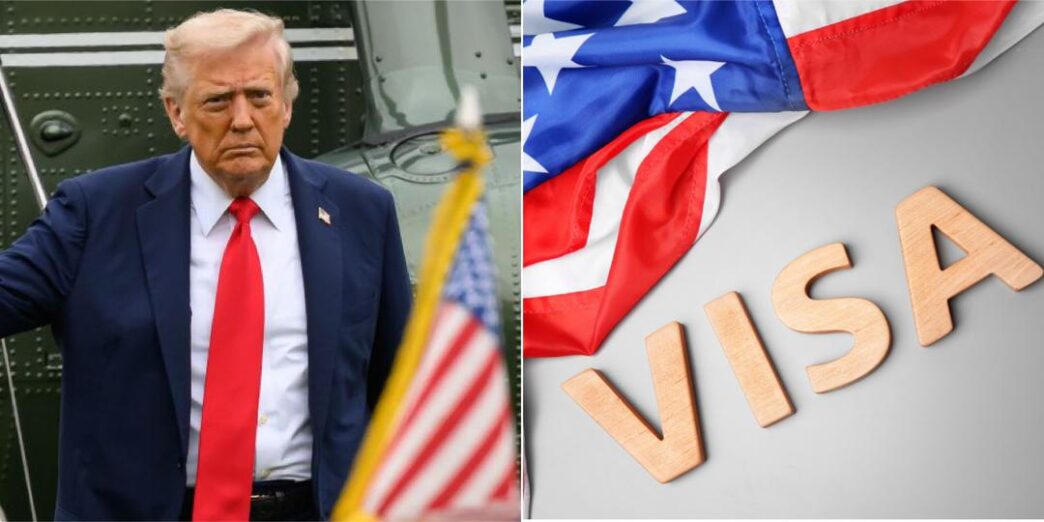
The United States has taken a step by enforcing visa restrictions linked to religious violence. The move has drawn global attention, especially as Nigeria remains a key focus.
Officials confirmed that the US visa ban Nigeria policy is already being implemented. This signals a stronger stance against individuals accused of violating religious freedom.
The announcement came from Mark Walker, the U.S. Principal Adviser for Global Religious Freedom. His statement made it clear that enforcement is no longer just a proposal.
“We have already executed on this policy, and we will continue to subject perpetrators to additional scrutiny,” Walker stated.
Furthermore, he issued a direct warning to those involved in such acts. “If you engage in persecution, you are not welcome in America. The United States is safer when we keep those responsible for religious persecution from entering our homeland.”
Meanwhile, the policy itself was first introduced in December 2025 by U.S. Secretary of State Marco Rubio. It allows visa restrictions on individuals connected to religious rights violations.
In addition, the measure applies to those who direct, fund, or support such actions. Immediate family members may also face restrictions where necessary.
Rubio had earlier described the move as a response to ongoing violence. He pointed to attacks on Christian communities in Nigeria as a major concern.
However, specific names of affected individuals have not been released.
Meanwhile, the policy is backed by U.S. immigration law. It aligns with Section 212(a)(3)(C) of the Immigration and Nationality Act.
Moreover, the action builds on earlier efforts by U.S. lawmakers. In November 2025, a resolution was introduced calling for visa bans and asset freezes.
The resolution highlighted groups such as the Miyetti Allah Cattle Breeders Association and Miyetti Allah Kautal Hore. These groups were mentioned in relation to alleged violations.
Furthermore, in February 2026, additional proposals were made targeting specific individuals. Among them was former Kano State Governor Rabiu Kwankwaso.
Meanwhile, Nigeria has faced ongoing international scrutiny over religious violence. Reports have pointed to attacks in the Middle Belt and northern regions.
The country was also previously listed as a Country of Particular Concern.
However, the Nigerian government has consistently rejected these claims. Officials have described some reports as exaggerated or politically influenced.
Despite this, the US visa ban Nigeria policy shows continued pressure from Washington. It also highlights a broader focus on global human rights enforcement.