


The United States has sharply escalated pressure on Venezuela after President Donald Trump announced what he described as a sweeping “blockade” of sanctioned Venezuelan oil tankers.
In a lengthy post on his social media platform, Trump declared that Venezuela was now “completely surrounded,” presenting the action as part of a broader strategy to reclaim assets he claimed were taken from the United States.
The announcement, therefore, signaled a new and unexpected phase in Washington’s long-running standoff with President Nicolas Maduro’s government.
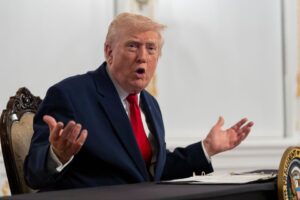
“Venezuela is completely surrounded by the largest Armada ever assembled in the History of South America,” Trump wrote.
“It will only get bigger, and the shock to them will be like nothing they have ever seen before until such time as they return to the United States of America all of the Oil, Land, and other Assets that they previously stole from us.”
While Trump did not clearly specify which assets were being referenced, analysts note that disputes date back to 2007, when Venezuela nationalized oil fields under former President Hugo Chavez. Several American oil companies lost control of assets during that period, a move that still shapes U.S.-Venezuela tensions today.
In addition, Trump announced “A TOTAL AND COMPLETE BLOCKADE OF ALL SANCTIONED OIL TANKERS going into, and out of, Venezuela,” raising immediate questions about enforcement.
Although the U.S. currently has 11 warships in the Caribbean, the largest presence in decades, experts note that a traditional blockade would require far greater naval resources.
However, the Venezuelan government reacted swiftly and forcefully.
In an official statement, authorities described Trump’s remarks as dangerous and unlawful.
“The President of the United States intends to impose in an absolutely irrational manner, a supposed naval military blockade on Venezuela with the objective of stealing the wealth that belongs to our homeland,” the statement said.
Meanwhile, data from shipping analysts suggest the stakes are high. Reuters recently reported that about 30 sanctioned vessels are involved in moving Venezuelan oil globally, with more than a dozen currently in Venezuelan waters.
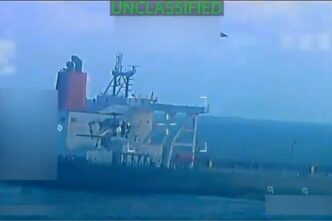
Last week, U.S. authorities seized a sanctioned oil tanker allegedly linked to illicit oil transfers between Venezuela and Iran.
Moreover, these developments come alongside ongoing U.S. military actions against drug trafficking vessels.
Since September, dozens of strikes have been carried out on boats accused of transporting narcotics, actions the administration says target networks fueling crime and addiction in the United States.
Trump’s rhetoric has also intensified. He labeled Maduro’s government a “Hostile Regime” and reiterated his recent designation of the Venezuelan leadership as a foreign terrorist organization.
“The illegitimate Maduro Regime is using Oil from these stolen Oil Fields to finance themselves, Drug Terrorism, Human Trafficking, Murder, and Kidnapping,” Trump wrote.
Therefore, as diplomatic tensions rise, the declared Venezuelan oil tanker blockade has introduced new uncertainty into regional security, global energy markets, and international law.