

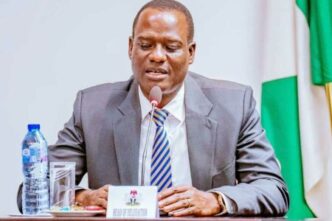
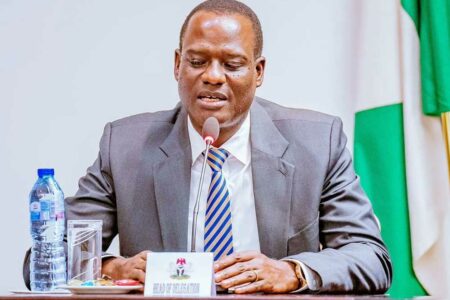
The drive to overhaul Nigeria’s tax system has taken a troubling turn, following a revelation by the head of the country’s tax reform committee.
What was meant to be a policy discussion has now exposed the personal risks behind one of Nigeria’s most ambitious economic reforms.
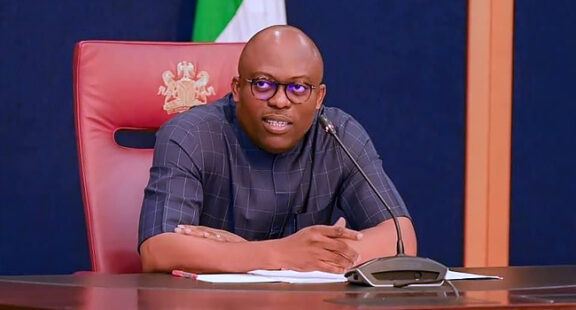
The Chairman of the Presidential Committee on Fiscal Policy and Tax Reforms, Taiwo Oyedele, has disclosed that his work on Nigeria’s tax reforms has exposed him to serious threats.
Oyedele spoke openly on Tuesday, January 13, describing the hidden dangers involved in fixing Nigeria’s tax structure.
His comments have since sparked wide debate across policy, business, and civic spaces.
Speaking at the event, Oyedele said reform efforts often come at a personal cost.
“Reforms are hard, and tax reforms are even harder. You need courage. I receive threats simply for trying to fix a broken system,” he said.
According to him, the pushback reflects deep-rooted problems within the country’s fiscal space.
He explained that many Nigerians mistrust how taxes are used, which makes compliance difficult.
Moreover, weak understanding of the link between taxes and public services has slowed progress.
Meanwhile, powerful interests affected by the changes have also resisted the reforms.
Oyedele noted that these pressures have made the process risky, stressful, and emotionally draining.
However, he maintained that the reforms remain necessary for Nigeria’s long-term stability.
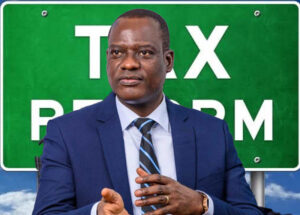
The Nigeria tax reforms were officially enforced on January 1, 2026. The government introduced four new laws to reshape tax collection and administration nationwide.
These include the Nigeria Tax Act 2025 and the Nigeria Tax Administration Act 2025.
Others are the Nigeria Revenue Service Establishment Act 2025 and the Joint Revenue Board Establishment Act 2025.
These laws are expected to simplify taxes, expand the revenue base, and reduce dependence on borrowing.
In addition, authorities believe the reforms will improve fairness and transparency.
Despite the backlash, Oyedele stressed that reform efforts must continue. He explained that Nigeria cannot sustain development without fixing revenue leakages.
Therefore, the Nigeria tax reforms are being positioned as a foundation for future growth.