


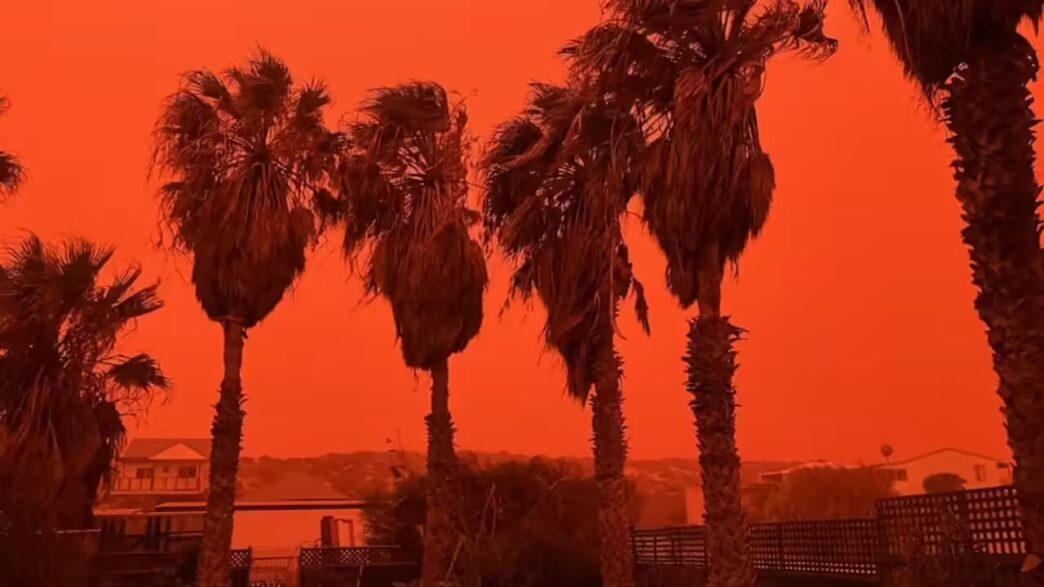
Residents across parts of Western Australia were left stunned as the sky suddenly turned a deep, eerie red. The dramatic scene unfolded in areas like Shark Bay and Denham, where daylight was quickly swallowed by thick dust clouds.
The rare phenomenon, now widely described as Western Australia red sky phenomenon, was caused by powerful winds from Tropical Cyclone Narelle.
Moreover, videos of the event spread rapidly online, sparking both fear and disbelief. The Western Australia red sky phenomenon was triggered when strong cyclone winds lifted large amounts of iron-rich soil into the air.
However, instead of normal daylight, only red light waves were able to pass through the dense particles. In addition, experts explained that this type of event, while rare, is not entirely unusual. Similar conditions were recorded in Sydney in 2009, when skies turned orange due to dust storms.
Meanwhile, Cyclone Narelle has proven to be a powerful and persistent storm system. It has crossed multiple regions, making it a rare “triple-strike” weather event.
The cyclone first hit Queensland before moving through the Northern Territory. It later regained strength over the ocean before reaching Western Australia.
At its peak, wind gusts exceeded 200 km/h, causing damage in coastal towns like Exmouth and Coral Bay. Roofs were reportedly torn off buildings, and infrastructure was affected.
Queensland Premier David Crisafulli described the impact, saying, “In many cases it will be the strongest wind people have experienced in this part of the state for a long, long time.”
However, others responded by sharing clips labeled “no filter” to confirm authenticity. This added to the growing attention around the unusual event.
Residents also reported that the sky darkened rapidly, almost like nightfall during the day. Meanwhile, emergency alerts remained active as conditions continued to pose risks. Although the cyclone has been downgraded, authorities have warned that danger still exists. The system is expected to weaken further as it moves southeast.
Watch video below;