


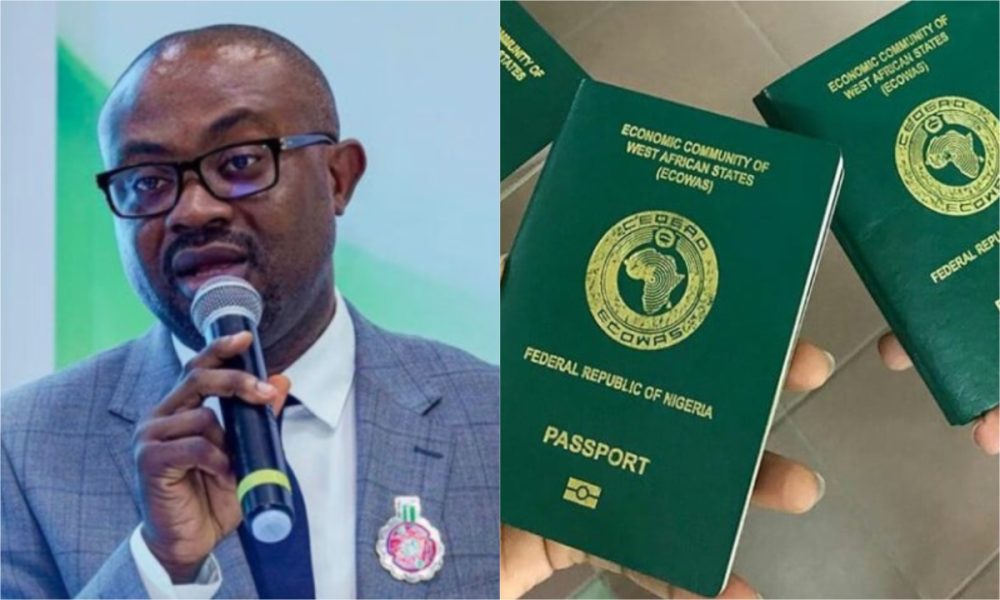
The Federal Government has ordered the immediate withdrawal and deactivation of Nigerian passports held by individuals who have formally renounced their citizenship.
The announcement was made by the Minister of Interior, Olubunmi Tunji-Ojo, who instructed the Nigeria Immigration Service (NIS) to enforce compliance without delay.
Consequently, affected individuals could lose access to their Nigerian passports once their renunciation is officially approved.
Moreover, the directive is said to apply strictly to individuals whose renunciation has been validated by the President, in line with constitutional provisions.
This step, therefore, reinforces the government’s intention to protect the integrity of national identity systems.
According to the minister, the Nigerian passport deactivation policy is aimed at preventing misuse of official travel documents. He stressed that citizenship goes beyond legal recognition and forms the foundation of national identity.
“(1) Any citizen of Nigeria of full age who wishes to renounce his Nigerian citizenship shall make a declaration in the prescribed manner for the renunciation.(2) The President shall cause the declaration made under subsection (1) of this section to be registered and upon such registration, the person who made the declaration shall cease to be a citizen of Nigeria,” the statement noted.
Furthermore, he explained that once citizenship is relinquished, all privileges tied to it must also cease. Therefore, holding a Nigerian passport after renunciation is no longer acceptable under the law.
However, authorities did not disclose how many Nigerians are affected or provide a clear timeline for full implementation. Meanwhile, the NIS is expected to begin compliance checks and deactivate affected passports within its database.
In addition, the policy highlights the legal separation between citizenship and documentation. This is particularly relevant for individuals who acquire foreign nationality and choose to give up their Nigerian identity.
The minister also emphasized ongoing reforms to strengthen border security and identity management.
“We will continue to strengthen systems that secure Nigeria’s borders, prevent identity fraud, preserve the sanctity of Nigerian citizenship, and facilitate legitimate travel,” he said.
Meanwhile, the Nigerian passport deactivation policy could reshape how citizenship transitions are handled in the future.