

The UK government has stepped back from plans that would have required workers to sign up to a digital ID scheme to prove their right to work.
The reversal follows months of intense criticism and public concern over the proposal, which had been positioned as a key tool to curb illegal migration.
The decision marks a sharp turn from earlier statements made by Prime Minister Sir Keir Starmer.
When the policy was first announced last year, Starmer had taken a firm stance, saying:
“You will not be able to work in the United Kingdom if you do not have digital ID. It’s as simple as that.”
The digital ID was expected to be rolled out by 2029 and, while described as voluntary, would have been required for employment checks.
However, following strong backlash, the government has now softened its position. Finance minister Rachel Reeves confirmed the change on Wednesday, after officials briefed the media that a single mandatory digital ID card would no longer be required for work.
Nevertheless, Reeves stressed that digital verification remains unavoidable.
“We are saying that you will need a mandatory digital ID to be able to work in the UK,” she told the BBC.
However, she added that flexibility would be allowed in how workers prove their status.
“Now the difference is whether that has to be one piece of ID, a digital ID card, or whether it could be an e-visa or an e-passport,” Reeves explained.
“We’re pretty relaxed about what form that takes.”
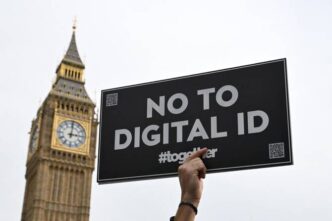
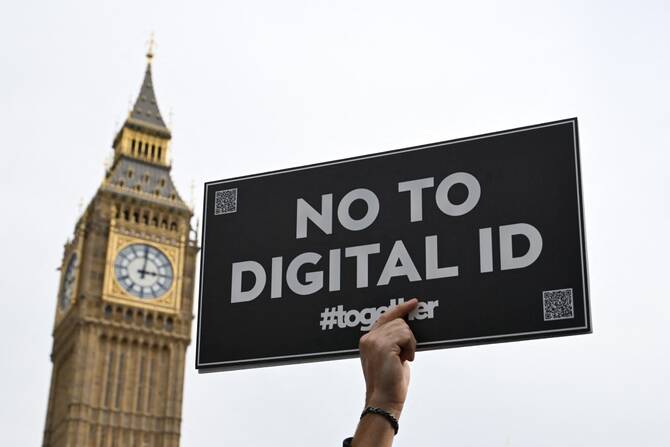
The digital ID policy had drawn heavy criticism since it was unveiled in September.

Moreover, opposition parties and civil liberties groups warned it could open the door to wider government surveillance.
Meanwhile, some far-right figures amplified fears that the system could be used to track vaccinations, carbon footprints, or even restrict access to travel and food.
However, the government has strongly denied those claims.
Officials insisted the scheme was designed only to simplify immigration checks and modernise the right-to-work process.
Despite those assurances, public mistrust continued to grow, therefore forcing a rethink.
In addition, the lack of a clear communication strategy was seen as a major weakness.
While ministers tried to reassure the public, concerns spread rapidly online.
This, in turn, added pressure on an already embattled government facing economic and political challenges.
Although the original plan has been dropped, digital checks are still expected to expand.
Employers will still be required to confirm a worker’s legal status using approved digital tools.
However, the shift away from a single digital ID card may calm fears and reduce resistance.