

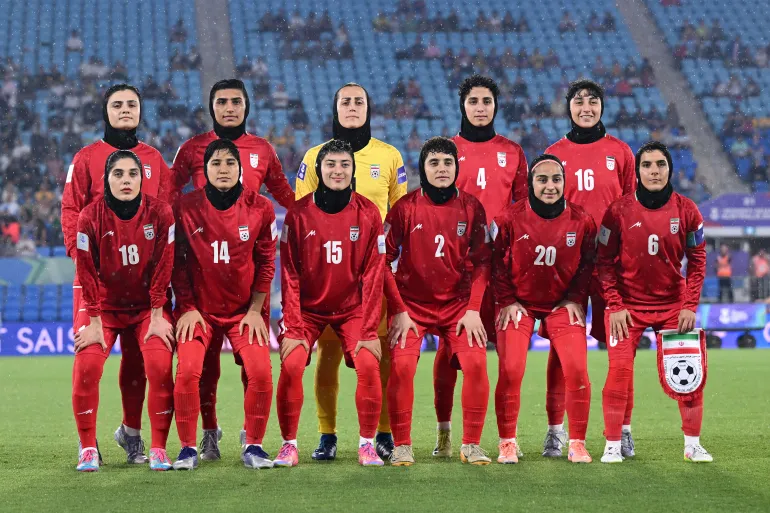
An international appeal has been made by United States President Donald Trump after concerns grew over the safety of the Iranian women’s football team following their exit from the Asian Cup in Australia.
The situation quickly gained global attention after reports suggested the players might face persecution if they returned to Iran.
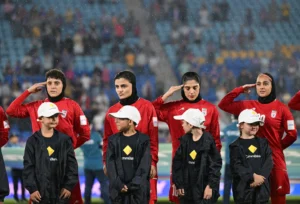
Their actions during the tournament, particularly their refusal to sing the national anthem before their opening match, reportedly triggered strong backlash from Iranian state supporters.
Moreover, the controversy intensified when one of the players was reportedly seen making a distress gesture while inside the team bus after their defeat.
The signal, which involved tucking the thumb into the palm and folding the fingers over it, is widely recognised as an international SOS sign for help.
As a result, the Iranian women’s football team asylum request has now become a major international issue involving governments and football authorities.
The team was eliminated from the tournament on Sunday after losing 2–0 to the Philippines in a match played at the Gold Coast in Australia. However, their exit from the competition quickly became overshadowed by concerns about their safety.
Meanwhile, several Iranian media outlets reportedly labelled the players as “traitors” after they did not sing the national anthem before their first game of the Asian Cup.
Reacting to the situation, Trump publicly urged the Australian government to offer protection to the players. He made the appeal in a post on his social media platform, Truth Social.
“Australia is making a terrible humanitarian mistake by allowing the Iranian Women’s National Soccer team to be forced back to Iran, where they will most likely be killed,” Trump wrote.
“Don’t do it, Mr. Prime Minister, give asylum. The U.S. will take them if you won’t. Thank you for your attention to this matter. President Donald J. Trump.”
His comments have further intensified the debate surrounding the Iranian women’s football team asylum request, as international sports bodies and governments assess the situation.
Meanwhile, world football governing body FIFA confirmed it is monitoring the matter closely. The organisation stated that it is already communicating with Australian authorities regarding the safety of the players.
FIFA emphasised that the protection of athletes remains a top priority.
Interestingly, the Iranian players did sing their national anthem during their last two matches in the tournament. However, their earlier protest had already sparked criticism from supporters of the Iranian government.
Furthermore, global football players’ union FIFPRO has also expressed concern about the situation. Beau Busch, the president of FIFPRO for Asia and Oceania, revealed that communication with the Iranian squad has been difficult.
“We’ve been asking (the Australian government) to work on the players having agency,” Busch said.
“It’s a really challenging situation. There may be players who want to return. There may be some players within the group who would like to seek asylum or would like to stay in Australia for longer. There may be some who are incredibly concerned about the potential journey home.”
Meanwhile, the situation is unfolding during a period of heightened geopolitical tension in the Middle East. Recent military actions involving the United States and Israel against Iran have already triggered retaliatory responses across the region.
Consequently, the wider political crisis has also affected international sports travel and tournament logistics. Several football authorities are reportedly reviewing contingency plans for upcoming competitions.