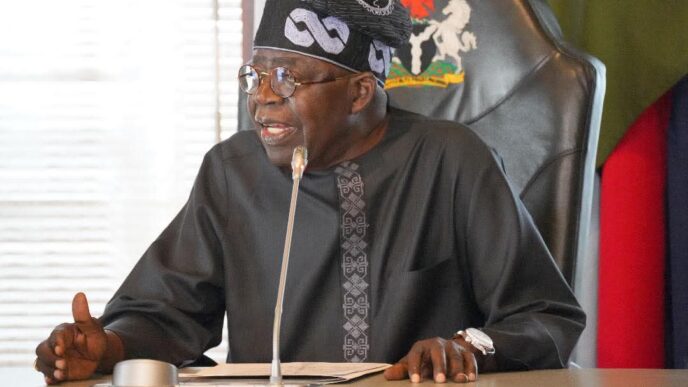


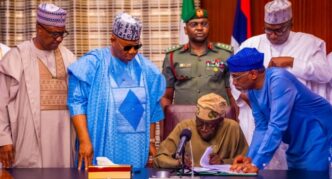

President Bola Tinubu has insisted that Nigeria’s new tax reform laws will be implemented as scheduled, despite growing political opposition and public debate.
The decision has come as a surprise to many, especially amid fresh calls for suspension from the opposition Peoples Democratic Party, PDP.
The President confirmed that the tax laws which took effect on June 26, 2025, alongside others billed for January 1, 2026, will move forward without delay.
According to him, concerns raised so far do not justify halting what he described as a critical reform process.
In a statement, Tinubu said, “The new tax laws, including those that took effect on June 26, 2025, and the remaining acts scheduled to commence on January 1, 2026, will continue as planned.”
He described the reforms as “a once-in-a-generation opportunity to build a fair, competitive, and robust fiscal foundation for our country.”
Moreover, the President stressed that the laws were not introduced to increase taxes.
Instead, he said they aim to reset the system, improve coordination, and strengthen trust between citizens and government.
“The tax laws are not designed to raise taxes, but rather to support a structural reset,” he added.
However, the PDP has taken a sharply different position. In a statement by its National Publicity Secretary, Ini Ememobong, the party argued that discrepancies between the version passed by the National Assembly and the one gazetted had triggered nationwide concern.
“Nigerians across all walks of life have loudly voiced their displeasure,” the party said.
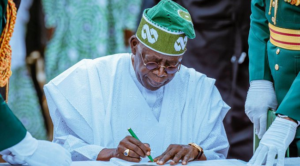
The PDP warned that alleged insertions of removed provisions raise serious legal and moral questions.
Therefore, it argued that implementation should be suspended until a full investigation is carried out. The party also accused the Tinubu administration of placing revenue above citizens’ welfare.
“This disposition clearly shows where the priority of the government lies between Nigerians and money,” the PDP stated.
It further reminded the President that “he is an employee of the people,” urging him to listen more closely to public opinion.
Meanwhile, the Nigeria Employers’ Consultative Association, NECA, has thrown its weight behind the reform.
Its Director-General, Adewale-Smatt Oyerinde, warned that delaying the reforms would be disastrous.
“Not moving forward will be a crime against the country,” he said.
Although NECA acknowledged errors in the gazetted document, it insisted they were not enough to derail the entire process.
Oyerinde explained that no reform is perfect and amendments can still be made.
Furthermore, he praised ongoing engagements led by the Presidential Committee on Fiscal Policy and Tax Reforms.
In addition, NECA expressed optimism that the new tax reform laws would begin to deliver economic benefits in 2026.
However, it urged the government to ensure stability and help macroeconomic gains reach ordinary Nigerians.