


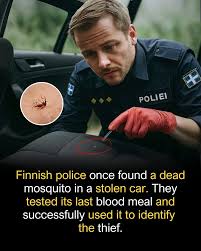
Finnish police have solved a car theft case using evidence few people would expect. A mosquito found inside a stolen vehicle became the key that cracked the case.
Investigators confirmed that the insect was discovered during a routine forensic search of the recovered car.
At first, it appeared insignificant. However, the find quickly turned into a major breakthrough.
According to investigators, the mosquito had recently fed on human blood. That detail changed everything. The blood meal was still preserved inside the insect’s body.
As explained by forensic teams, the mosquito effectively became “a biological container of forensic evidence.”
Scientists were able to remove the blood and begin laboratory testing. Moreover, the sample was suitable for full DNA analysis.
Using standard genetic profiling techniques, experts extracted a clear DNA profile. The profile was later matched to a suspect already known to authorities. Therefore, the evidence directly linked the individual to the stolen vehicle.
Police say the discovery was completely unexpected. However, it proved decisive in closing the investigation. The suspect was subsequently arrested after the DNA match was confirmed.
Forensic specialists involved in the case explained that “even indirect biological traces can yield usable DNA.”
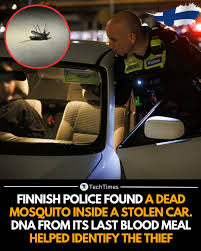
In addition, they noted that modern science allows evidence to be recovered from unlikely sources. This includes insects, environmental traces, and microscopic samples.
The case has since drawn attention across forensic circles. Moreover, it highlights how advances in DNA preservation are reshaping police work.
Evidence that once seemed useless can now be vital.
Experts also stressed that this method does not replace traditional techniques. Fingerprints, fibres, and footprints remain important. However, unusual findings can now support or strengthen existing cases.
The use of mosquito DNA evidence shows how far forensic science has evolved. Investigators are no longer limited to obvious clues. Instead, they can turn small details into strong leads.
Meanwhile, law enforcement agencies are reviewing how similar techniques may be applied in future cases. The goal is to improve accuracy while reducing unsolved crimes. This approach may also help in cold cases.
For the public, the case serves as a reminder. Crime scenes can hold hidden evidence in unexpected places. Even a single insect can tell a powerful story.