

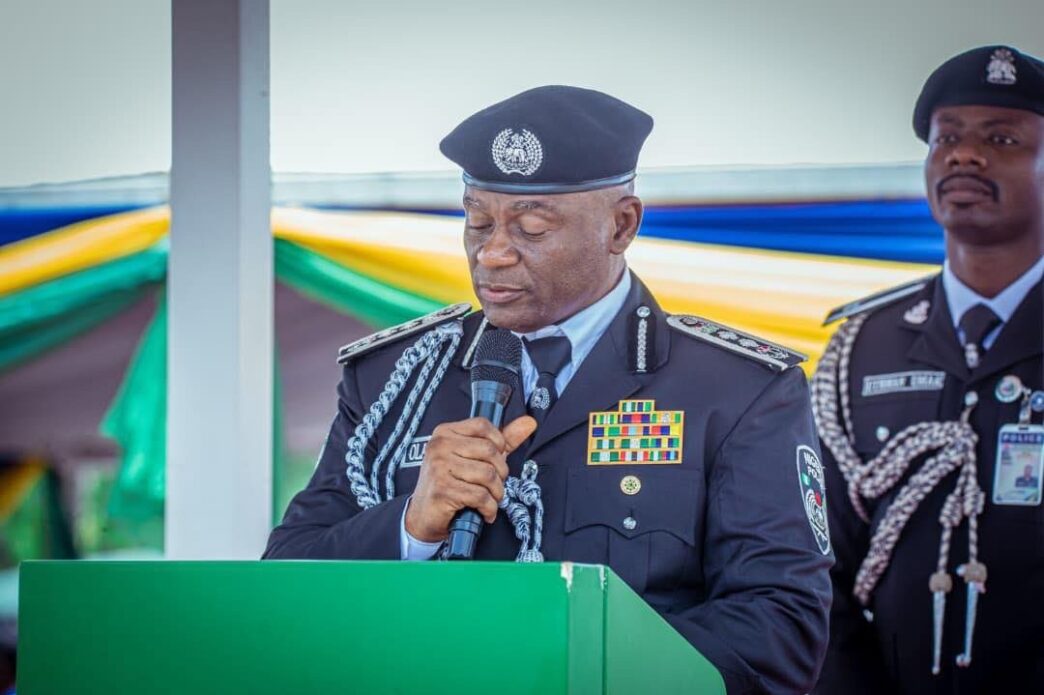
“Leadership is tested not when the path is clear, but when the unexpected demands courage.”
What began as a quiet countdown to retirement suddenly turned into a historic rise. On his 60th birthday, Inspector General of Police, Olatunji Disu, stands at the center of one of Nigeria’s most unexpected leadership shifts.
Born on April 13, 1966, in Lagos, Disu’s journey reflects resilience and rare timing. He was raised in Ajegunle, one of Lagos’ most vibrant yet challenging neighborhoods.
His time at St. Gregory’s College in Obalende further revealed his bold character, as he often stood up to bullies and protected others. This fighting spirit naturally led him into boxing, where he trained under renowned coach Richard Rodriguez in Alakoro. However, after a tough sparring session that left a lasting impression, he stepped away from boxing.
At Lagos State University, where he studied English (Education), Disu transitioned into martial arts. He first joined the taekwondo club before eventually focusing on judo, where he found his true strength. Over time, he became a decorated judoka, representing both Lagos State and the Nigeria Police in competitions, earning medals and recognition. “
Interestingly, his journey into policing was inspired by judo. After a match, an opponent turned friend encouraged him to consider a career in the Nigeria Police Force. That moment proved decisive. Since graduating from the Police Academy in Kaduna in 1993, Disu has steadily risen through the ranks.
Throughout his career, he has built a reputation in specialized operations. He has led anti-robbery units in Ondo and Oyo, headed anti-kidnapping efforts in Rivers State, and played key roles in counter-terrorism operations. His work has largely focused on tackling violent crime and handling complex investigations.
At a moment when many officers prepare to exit quietly, fate intervened. Moreover, just forty-eight days before his scheduled retirement, he was appointed acting Inspector General of Police.
This sudden transition has since shaped what many now describe as a defining era for the force. The Nigeria Police reform under Disu has quickly become a major talking point across the country.
Before this appointment, Disu had barely settled into a new role. He had spent only two weeks as an Assistant Inspector General in Lagos.
Then came the announcement that changed everything.

President Bola Tinubu named him as the new police chief. Therefore, what seemed like an ending instantly became a new beginning.
This moment was not just surprising. It was symbolic of opportunity meeting preparation.
Reaching 60 in such a demanding career is itself remarkable. In addition, doing so while still rising to the top reflects both endurance and timing.
Many of his peers have long left the stage. However, Disu’s story took a different turn.
Since assuming office, Disu has moved quickly to redefine policing standards. Moreover, his early actions suggest a strong focus on accountability and public trust.
One of the key pillars of the Nigeria Police reform under Disu is the revival of the Police Complaint Response Unit. This unit has been repositioned to address misconduct swiftly.
A recent incident highlights this shift clearly. A Nigerian identified as Rhapstar publicly shared his experience after recovering money extorted by officers.
His testimony has drawn attention nationwide. It reflects a growing belief that change may finally be taking root.
Furthermore, Disu has issued strict directives banning extortion, illegal detention, and misconduct. These orders were communicated across commands for immediate enforcement.
According to reports, the directive followed concerns over declining public trust. Therefore, urgent steps were taken to restore confidence in the system.
An internal communication dated April 11, 2026, confirmed the widespread circulation of these orders. Meanwhile, officers have been warned that violations will not be tolerated.
This shift became more visible after a troubling video surfaced online. The clip exposed misconduct by officers in Lagos.
In the video, one officer was heard saying, “I will loose guard you.” The statement sparked public outrage.
However, the response from police authorities was swift. The officers involved were summoned, and investigations were immediately launched.
This reaction has been seen as a sign of renewed commitment to accountability. Moreover, it shows that the leadership is willing to act decisively.
Preliminary findings revealed that the incident occurred in May 2025. However, it was only reported later due to growing public confidence.
This confidence stems from Disu’s encouragement for citizens to speak up. Therefore, more cases are now being brought forward.
Beyond discipline, structural reforms are also underway. The number of tactical units has been reduced nationwide.
This measure aims to improve supervision and reduce abuse of power. In addition, it ensures better deployment of officers to regular duties.
Another major step is the push for state policing. A framework has already been developed and submitted for legislative review.
However, concerns remain about the proposed timeline.
Meanwhile, welfare reforms have also been introduced. Families of fallen officers have received financial support through a dedicated scheme.
Within weeks, over ₦2.4 billion was disbursed to affected families. This gesture has been widely praised.
Legally, Disu’s tenure is protected under the Police Act 2020. Specifically, Part III, Section 7 outlines the procedures governing the appointment, removal, powers, and tenure of the office.
According to Section 7(3), the IGP is appointed by the President based on the advice of the Police Council, and must be selected from serving members of the Nigeria Police Force. Furthermore, Section 7(4) states that the IGP can only be removed on the grounds of gross misconduct, constitutional violation, or incapacity. In addition, Section 7(5) provides that such removal must also follow due process, requiring the President to act on the advice of the Police Council.
Most importantly, Section 7(6) establishes that the Inspector General of Police “shall hold office for four years,” making the tenure fixed and clearly defined under the law.
The law clearly states that the Inspector General serves a four-year term.
Therefore, stability in leadership is expected. This provides room for long-term reforms to take root.
Two months may be too short for full evaluation. However, early signs are promising.
The reforms have already begun to reshape public perception. Moreover, they offer hope for a more accountable police force.
As he marks his birthday, Disu’s story stands as both rare and inspiring.
For many Nigerians, the expectation is clear. The momentum must not slow down.
As reforms continue, one message stands firm. No officer is above the law.
Happy birthday, IGP Tunji Disu. May your leadership bring lasting change.